
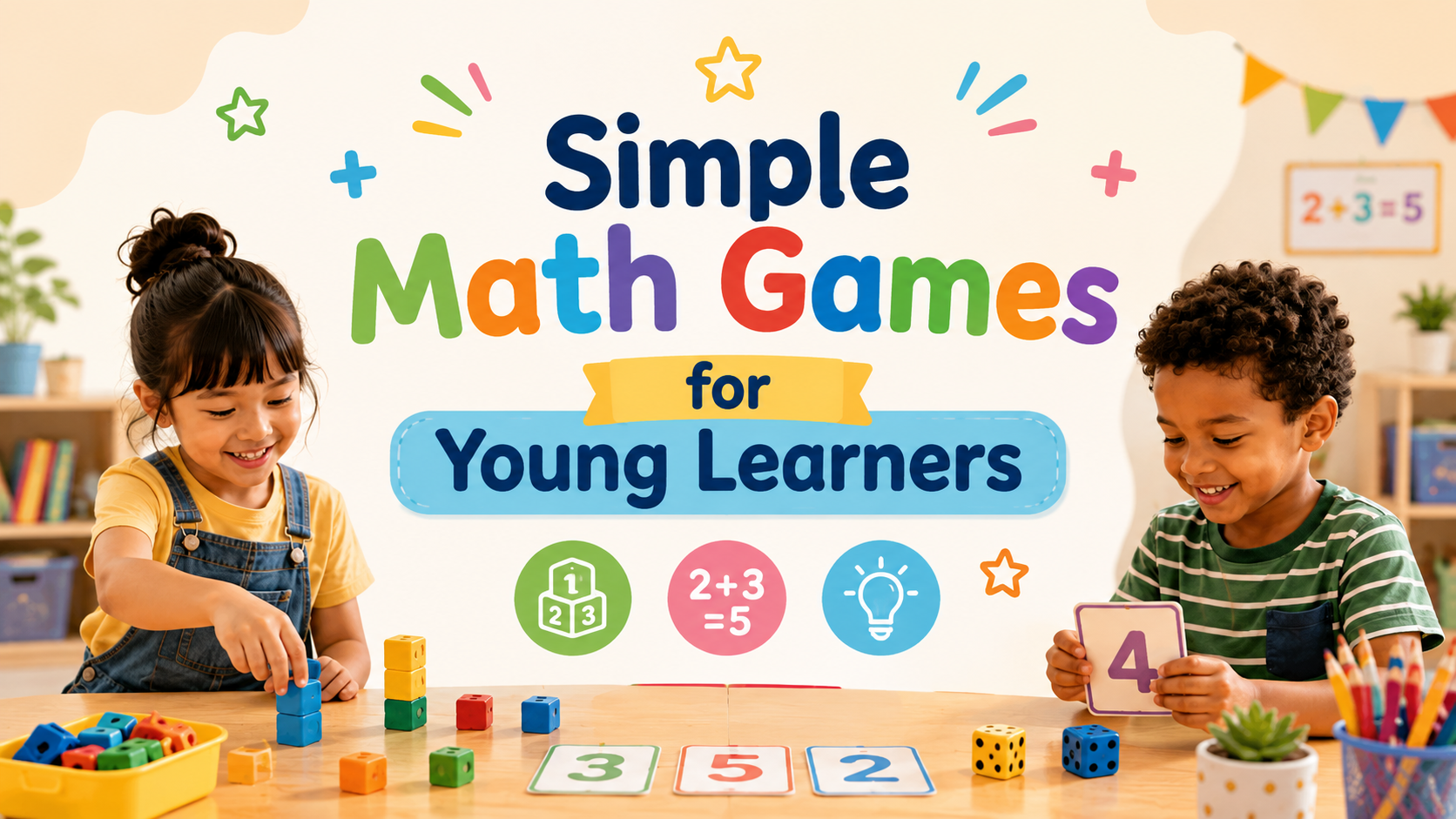
Math can be fun! Try these games:
- Counting with Objects
- Math Bingo
- Number Line Hopscotch
These games encourage children to practice math skills in an engaging way.
Math doesn’t always have to mean worksheets, pencils, and sitting at a desk. For young children, some of the best math learning happens through play, movement, and everyday objects.
Simple games can help children practice important math skills while building confidence and having fun at the same time. And the good news? You don’t need expensive supplies or complicated activities.
Here are three easy math games you can try at home or in the classroom.
1. Counting With Objects
Grab a handful of everyday objects such as buttons, blocks, crayons, small toys, or even snacks.
Ask your child to count the objects one at a time.
Once counting becomes comfortable, try simple questions such as:
- How many do you have altogether?
- What happens if we add one more?
- What happens if we take two away?
- Can you make a group of five?
- Which group has more? Which has less?
This simple activity helps children connect written and spoken numbers with actual quantities.
Learning skills: counting, number recognition, one-to-one correspondence, addition, and subtraction.
2. Math Bingo
Bingo is a fun way to practice math without making it feel like a lesson.
Create a simple bingo card with numbers your child is learning. Instead of simply calling out a number, give them a math problem.
For example, instead of saying “5,” you might say:
“What is 3 + 2?”
Your child solves the problem and covers the number 5 on the card.
For younger learners, you can keep the problems very simple. Older elementary children can practice subtraction, multiplication, or other skills they are learning.
Learning skills: number recognition, mental math, addition, subtraction, and problem-solving.
3. Number Line Hopscotch
Sometimes children learn best when they can move.
Create a number line using sidewalk chalk outside or pieces of paper on the floor inside. Write one number on each space.
Call out a number and have your child jump to it.
Then begin adding simple directions:
“Start on 3 and jump forward 2 spaces.”
“What number did you land on?”
You can also practice subtraction by having your child jump backward.
This activity gives children a visual and physical way to understand how numbers relate to one another.
Learning skills: number order, addition, subtraction, counting forward, and counting backward.
Keep Math Simple and Fun
Children don’t need every math activity to feel like schoolwork. A few minutes of playful practice can help strengthen the same skills they are learning in the classroom.
Counting objects at the kitchen table, playing a quick game of bingo, or hopping along a homemade number line can turn an ordinary moment into a learning opportunity.
Most importantly, give your child time to think, make mistakes, and try again.
Math confidence grows little by little — and learning can begin with something as simple as a game.
Leave a Reply