
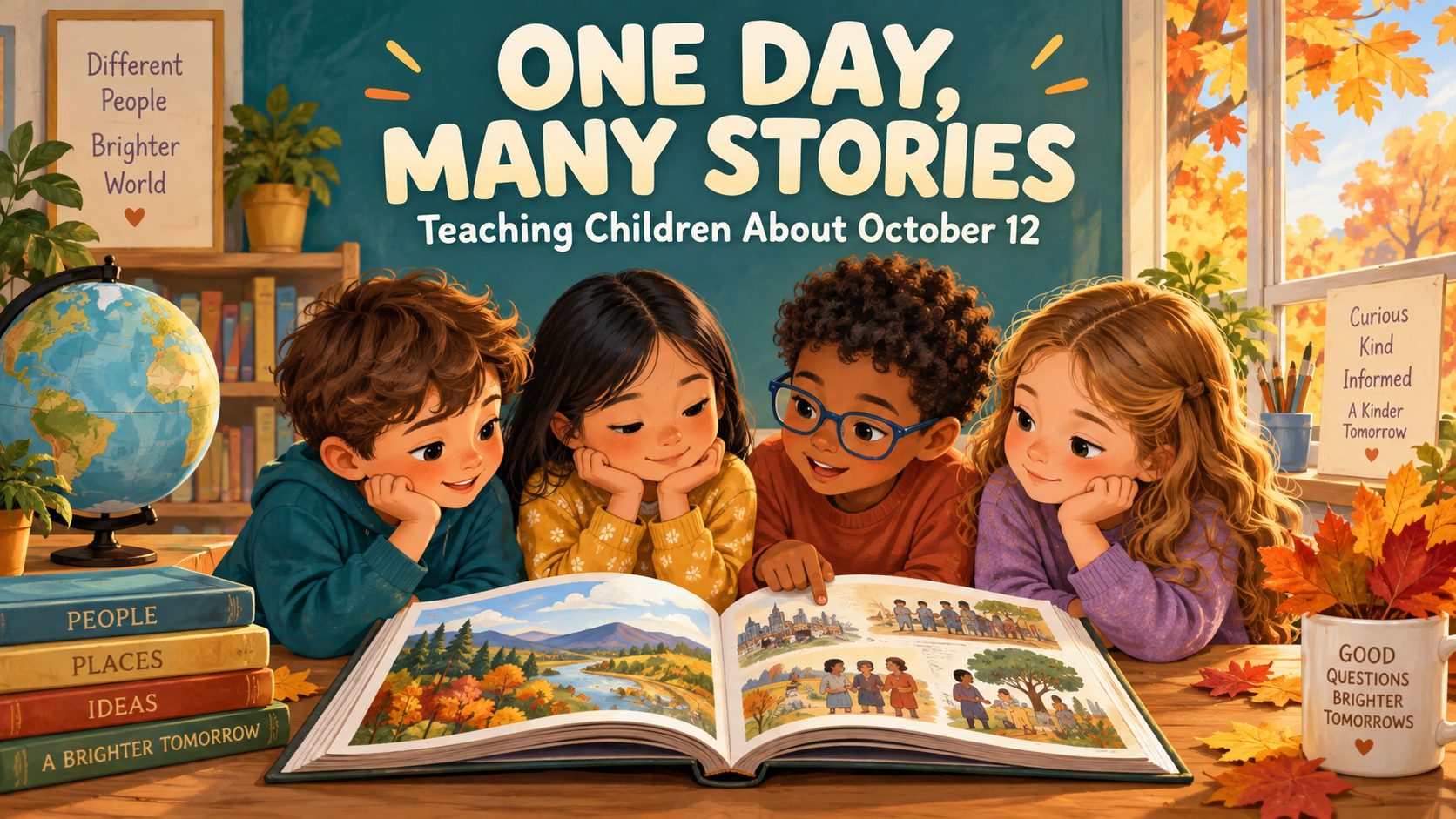
History is filled with stories.
Sometimes two people can experience the same event but remember it differently. They may notice different details, have different feelings, or understand the event from different perspectives.
October 12 gives parents and teachers an opportunity to help children explore this idea. Columbus Day and Indigenous Peoples’ Day are both observed around this date, but they tell different parts of history.
Instead of asking children to choose one story and ignore the other, we can teach them to listen, ask thoughtful questions, and remember that one day can hold many stories.
What Is Columbus Day?
Columbus Day remembers Christopher Columbus’s voyage across the Atlantic Ocean in 1492.
His voyage created lasting connections between Europe and the Americas. It is also important to remember that Indigenous peoples had already been living throughout the Americas for thousands of years.
The land Columbus reached was not empty or waiting to be discovered. It was home to established communities with their own families, cultures, languages, and traditions.
What Is Indigenous Peoples’ Day?
Indigenous Peoples’ Day recognizes the histories, cultures, experiences, and contributions of Indigenous peoples.
Indigenous people are not only part of the past. Native nations and Indigenous communities continue to exist today. They have distinct cultures, histories, governments, traditions, and stories.
There is no single Indigenous culture. When possible, children should learn the specific names of individual Native nations rather than treating every Indigenous person as part of one group.
Helping Children Understand Different Perspectives
A perspective is the way someone sees or understands something.
Imagine that two children visit the same riverside park. One child is visiting for the first time. The other child has helped care for the park with their family for many years.
The visitor might notice the beautiful water, unfamiliar plants, or exciting walking trails. The longtime caretaker might know which animals live nearby, remember family experiences at the park, or understand how the area has changed.
Both children are looking at the same place, but they bring different knowledge and experiences with them.
History works in a similar way. Listening to more than one perspective can give us a fuller understanding of what happened.
Teaching This Day Respectfully
October 12 can involve complicated and painful history. Children do not need every difficult detail at once, but they deserve explanations that are honest and appropriate for their ages.
Here are a few ways to guide the conversation:
- Explain that Indigenous peoples lived in the Americas long before Columbus arrived.
- Speak about Indigenous communities in the present tense, not only as people from long ago.
- Teach children that different Native nations have different histories and traditions.
- Avoid activities involving pretend headdresses, costumes, or stereotypical crafts.
- Encourage children to listen before forming an opinion.
- Remind them that learning new information is part of growing.
The goal is not to make children feel guilty about history. The goal is to help them become curious, compassionate, and respectful learners.
Free One Day, Many Stories Activity
The One Day, Many Stories printable gives children a gentle introduction to perspective and respectful historical learning.
The three-page activity includes:
- Same Scene, Different Viewpoints
Children imagine what a new visitor and a longtime caretaker might notice about the same place. - Indigenous Peoples: Then and Now
A true-or-false activity helps children understand that Indigenous communities are part of both history and the present day. - Listen, Learn, Respect
Children reflect on their questions and make a promise to approach other people’s stories with care.
[Download the free One Day, Many Stories activity PDF here.]
Answer Key
- Indigenous peoples are only part of the past — False
- Different Native nations have different traditions and histories — True
- Indigenous people live in communities today — True
- One story can explain every person’s experience — False
Questions to Discuss Together
After completing the printable, ask your child or students:
- Why might two people remember the same event differently?
- What can we learn by listening to more than one person?
- Why is it important to learn the name of a specific Native nation?
- How can we ask questions respectfully?
- What is one new thing you learned today?
There does not need to be a perfect answer to every question. Giving children room to wonder is an important part of learning.
One Day Can Hold Many Stories
History becomes more meaningful when children learn to look beyond one simple account.
They can recognize Columbus’s voyage as an important historical event while also learning that Indigenous peoples were already living in the Americas and that colonization caused lasting harm.
Children can hold more than one truth at a time. They can listen carefully, learn honestly, and treat people’s stories with dignity.
This October 12, let us help children remember three important words:
Listen. Learn. Respect.
Leave a Reply