
Back-to-school mornings can feel like a race against the clock.
“Did you brush your teeth?”
“Where are your shoes?”
“Did you put your homework in your backpack?”
“Hurry up! We’re going to be late!”
Then school ends, and another round begins.
“Put your backpack away.”
“Did you give me your school papers?”
“Have you done your homework?”
“Go get ready for bed.”
For parents, it can start to feel like you’re responsible for remembering everything for everyone.
But what if we looked at these everyday moments a little differently?
Instead of simply trying to get children out the door faster, we can use routines to help them learn something much bigger:
How to take responsibility for their own day.
A simple checklist can help move a child from:
“Mom, what do I do next?”
to:
“Let me check my list.”
And eventually:
“I already did it!”
That growing independence is the real goal.
Start With a Plan, Not Perfection
Children have a lot to remember when school begins again.
New schedules. New classrooms. Homework. Earlier bedtimes. Backpacks. Lunches. Activities. Papers that need to come home.
So rather than expecting them to remember everything immediately, give them a predictable routine they can follow.
You don’t need an elaborate organizational system.
Start with these five simple routines for calmer school days.
1. Morning Routine: Start the Day With Less Rushing
A predictable morning routine helps children know what needs to happen before it’s time to leave.
Your child’s checklist might include:
☐ Get dressed
☐ Make my bed
☐ Brush my teeth and hair
☐ Eat breakfast
☐ Pack my lunch and water bottle
☐ Check my backpack
☐ Put on my shoes and get ready to go
Here’s where the checklist becomes especially helpful.
Instead of repeatedly saying:
“Go brush your teeth.”
Try:
“What’s next on your checklist?”
At first, your child may still need reminders. That’s okay.
The goal isn’t to eliminate every reminder tomorrow morning. It’s to gradually transfer some of the responsibility to your child.
2. After-School Routine: Unpack, Recharge & Reset
Children come home carrying more than backpacks.
They’re often tired after listening, learning, following directions, interacting with classmates, and navigating a busy school day.
So an after-school routine doesn’t have to mean immediately sitting down to work.
It can include time to unpack and decompress.
For example:
☐ Put my backpack in its place
☐ Put away my lunchbox and water bottle
☐ Give important school papers to an adult
☐ Have a snack
☐ Take a short break
☐ Check what I need to do this afternoon
Having a designated place for backpacks, lunchboxes, shoes, and school papers can also eliminate some of the frantic searching later.
3. Homework Routine: Give Schoolwork a Predictable Home
“Where’s your homework?”
That’s another question parents can get tired of asking.
A simple homework routine can help.
Your family might decide that homework happens:
- After a snack and short break
- At a particular desk or table
- Before screen time or other evening activities
The exact routine will depend on your family.
What matters most is that your child begins to understand:
This is when and where I take care of my schoolwork.
Their checklist could include:
☐ Check my homework
☐ Complete my reading or practice
☐ Put finished work in my folder
☐ Put the folder back in my backpack
☐ Check whether anything needs a parent’s signature
That last step—putting completed homework back into the backpack—can be just as important as doing it!
4. Nighttime Routine: Make Tomorrow Easier Tonight
Sometimes the best way to fix a stressful morning is to look at what happens the night before.
A nighttime routine might include:
☐ Choose tomorrow’s clothes
☐ Make sure my backpack is ready
☐ Check tomorrow’s schedule
☐ Put away toys and belongings
☐ Brush my teeth
☐ Read, pray, or have quiet time
☐ Get into bed at my regular bedtime
Think about how many morning problems can disappear when the backpack is already packed and the clothes are already chosen.
A few minutes of preparation tonight can create a much calmer start tomorrow.
5. Weekend Reset Routine: Prepare for the Week Ahead
Weekends shouldn’t feel exactly like school days.
Children need play, rest and family time too.
But a light weekend routine can help prevent everything from piling up before Monday morning.
Saturday
Saturday might include:
☐ Make my bed
☐ Put dirty clothes in the hamper
☐ Help with one household chore
☐ Tidy my room
☐ Put school belongings where they belong
☐ Enjoy family and play time
☐ Check what I need for Sunday
☐ Prepare my clothes for church
Sunday & Church Day
For Catholic families, Sunday can have its own gentle rhythm.
Your child might:
☐ Get dressed for church
☐ Brush teeth and hair
☐ Eat breakfast
☐ Make sure I have what I need for Mass
☐ Get myself ready to leave with my family
Later in the day, the routine can shift toward Monday:
☐ Check Monday’s schedule
☐ Choose Monday’s clothes
☐ Pack my backpack
☐ Get to bed on time
The goal isn’t to give a child a gold star simply for going to Mass.
Instead, we’re helping children practice taking responsibility for getting themselves prepared.
Faith becomes part of the family’s natural weekly rhythm rather than another task to accomplish.
Turn the Checklists Into a Routine Binder
Now let’s make those five routines practical.
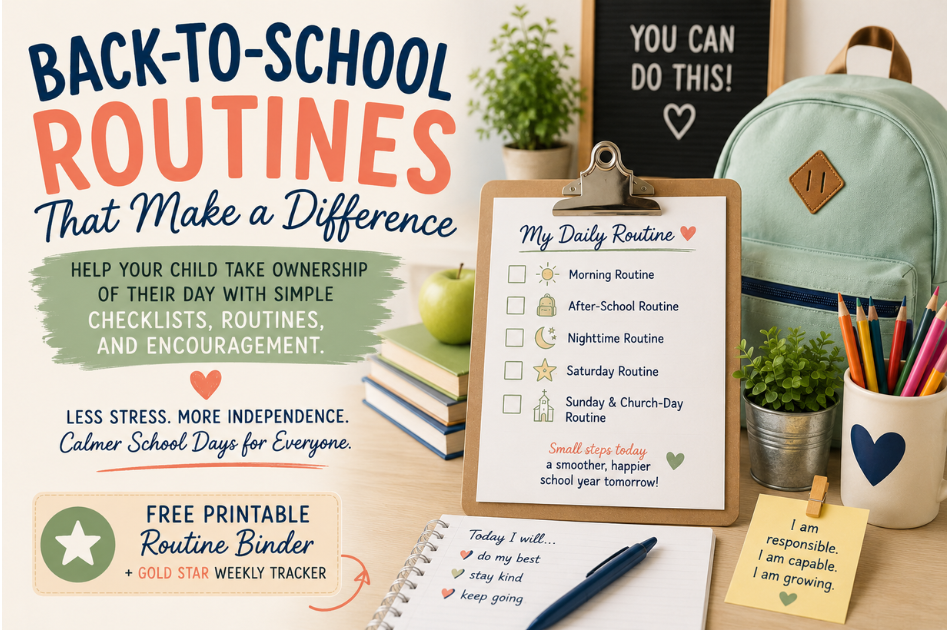
Consider giving your child their own Back-to-School Routine Binder.
Put their name on it and let it have a designated place in their bedroom or another easy-to-reach location.
Inside, you can keep their:
- Morning Checklist
- After-School Checklist
- Nighttime Checklist
- Saturday Checklist
- Sunday & Church-Day Checklist
- Gold Star Tracker
- Weekly Check-In
Having their own binder helps reinforce an important message:
This is your routine.
Make It Reusable
You don’t have to print new checklists every day.
You can laminate the pages and use dry-erase markers.
Or slide each checklist into a clear plastic sheet protector and put the pages into a three-ring binder.
Then your child can:
Check it → finish the routine → wipe it clean → start again tomorrow.
And you don’t even have to use a binder.
Put a laminated checklist on a clipboard and hang it on the child’s bedroom wall or door.
Put the Morning Checklist near their clothes.
Keep the After-School Checklist near the backpack area.
Put the Nighttime Checklist near the bed.
There are endless possibilities.
The important thing is that the checklist is somewhere your child can see it, reach it and use it independently.
Let Your Child Hold the Marker
This is one of my favorite parts of this system.
Don’t do all the checking for them.
Give your child the dry-erase marker.
When they brush their teeth:
☑ Brush my teeth.
When the backpack is ready:
☑ Pack my backpack.
When their clothes are ready for tomorrow:
☑ Choose tomorrow’s clothes.
Those little checkmarks provide a visible sense of:
“I did that.”
The parent is still there to teach, guide and encourage—but the child begins taking ownership.
Add a Gold Star ⭐
You can also make the routine fun with a simple 7-Day Gold Star Tracker.
At the end of each day, look at how things went.
Did your child make a genuine effort?
Did they check their routine?
Did they remember something without being told?
Did they take a little more responsibility than they did before?
Add a gold star.
But remember:
The goal isn’t seven perfect days.
One reminder doesn’t have to erase an entire day’s progress.
You’re looking for effort, growth and increasing independence.
Don’t Just Count the Stars—Evaluate the Week
At the end of the week, sit down together for a few minutes.
Celebrate the wins first.
Then ask:
What went really well this week?
Which routine was easiest?
What did you remember without being reminded?
Which part was difficult?
What could make that part easier next week?
Maybe your child earned seven stars but still struggled with one particular step.
Or maybe they earned four stars—but did something independently that they couldn’t do the week before.
That’s progress too.
Look for the Weak Spot
Suppose mornings are going beautifully, but every evening becomes stressful.
Instead of immediately assuming:
“My child just won’t follow the routine.”
Get curious about the routine itself.
Maybe your child is tired.
Maybe there are too many steps.
Maybe bedtime needs to begin earlier.
Maybe clothes should be selected before dinner rather than right before bed.
Maybe the backpack doesn’t have a designated place.
Ask your child:
“What part is hard for you?”
and
“What do you think would make this easier?”
Then work on the weak spot together.
We’re not only evaluating the child.
We’re evaluating whether the system is actually helping the child.
Small Routines Can Build Big Skills
These checklists aren’t really about backpacks, toothbrushes or making beds.
They’re tools for teaching children how to:
plan, remember, organize, prepare and take responsibility.
And little by little:
“Mom, what do I do?”
can become:
“I’ll check my list.”
And someday:
“I’ve already got it.”
That’s when you’ll know the checklist did its job.
Choose the Routine Printable That Works for Your Family ⭐
Every family is different, so I’ve created two free options to help you put these routines into practice.
Want Something Simple? Start With the One-Page Printable
If you want all five routines in one easy place, download the 5 Simple Back-to-School Routines One-Page Printable.
It includes:
- Morning Routine
- After-School Routine
- Homework Routine
- Nighttime Routine
- Weekend Reset Routine
Print it and hang it on the wall, place it on a clipboard, or laminate it and let your child use a dry-erase marker to check off each step.
[Download the FREE One-Page Routine Printable →]
Want More Support? Download the Full Routine Binder
If you’d like individual checklists your child can follow throughout the day and week, download the Back-to-School Routine Binder.
Inside you’ll find:
- Morning Checklist
- After-School Checklist
- Nighttime Checklist
- Saturday Checklist
- Sunday & Church-Day Checklist
- 7-Day Gold Star Tracker
- Weekly Routine Check-In
- Tips for using your pages with sheet protectors, dry-erase markers, binders, or clipboards
[Download the FREE Back-to-School Routine Binder →]
You don’t have to use every page or every routine. Choose what works for your child and adjust it as you go.
Most importantly, let your child make it their own.
Because the goal isn’t perfection.
It’s fewer:
“Hurry up!”
moments…
and more:
“I’ve got this.” ❤️
Leave a Reply